
Helmut Claas-Scholarship
Helmut Claas-Scholarship
Celebration!
Celebration!
Do you feel passionate about agriculture and/or agricultural engineering? The Helmut Claas-Scholarship is aimed at dedicated students of Engineering, Agricultural studies and Economics and supports you for a 12 months period. If you have just recently completed your bachelor thesis, please read on and apply.








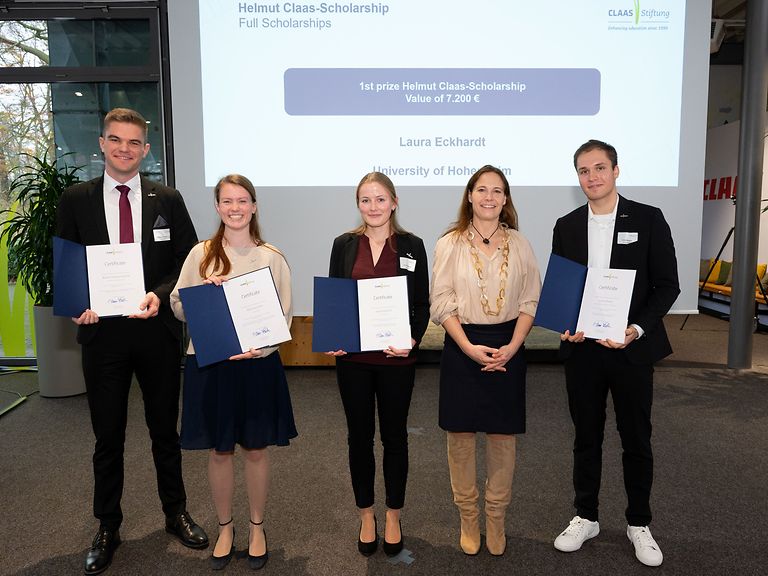
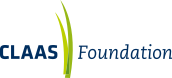
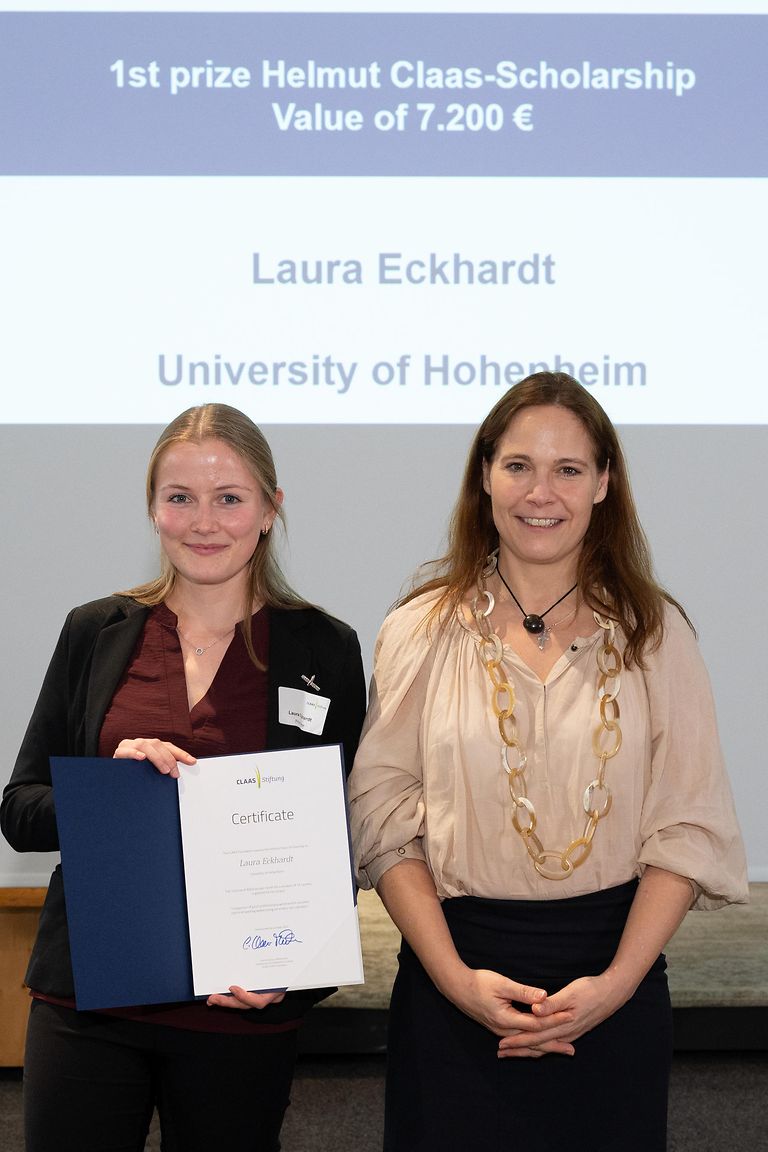
Cathrina Claas-Mühlhäuser (second from right) presented the certificates to the scholarship recipients (from left) Bendix Markus Sommer, Flora Lucy Gray, Laura Eckhardt and Lukas Musser.

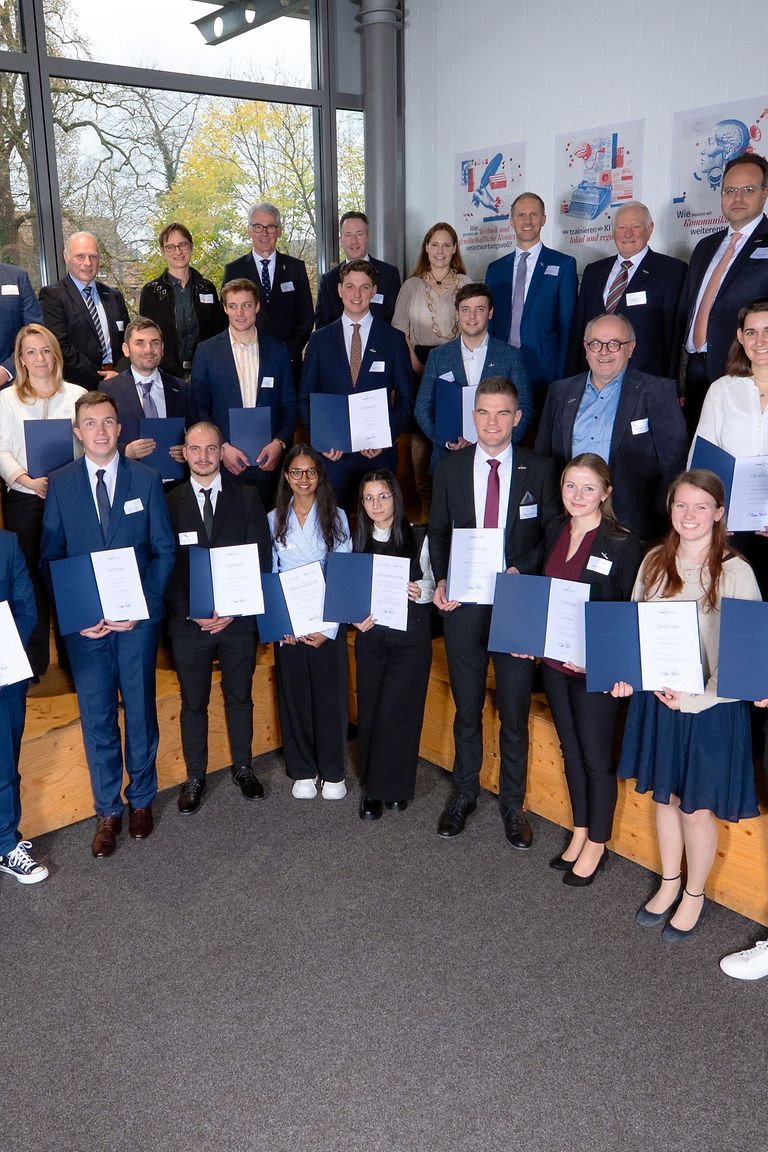
Our prize winners
Our prize winners
Interviews with our 2025 prize winners
Interviews with our 2025 prize winners
More videos
2025
2025
Scholarships
1st prize: Laura Eckhardt from the University of Hohenheim showed how artificial intelligence can help make agricultural work processes not only more efficient but also more sustainable. Her research compares tried-and-tested methods with AI-supported speed control in soil cultivation – an approach with potential for the agriculture of tomorrow.
2nd prize: Flora Lucy Gray from Durham University (UK) investigated how maize cultivation and nitrogen-fixing plants can serve as indicators for different farming systems. Her comprehensive analysis of the effects of regenerative and conventional agriculture on soil quality provides valuable insights for sustainable practices.
3rd prize: Lukas Musser from Weihenstephan-Triesdorf University of Applied Sciences impressed with his innovative development of an adaptive welding device for vehicle frames, which can be supplemented with a welding robot in the future – a highly relevant response to increasing automation requirements.
4th prize: Bendix Markus Sommer from Osnabrück University of Applied Sciences presented a particularly practice-oriented contribution with his work on the evaluation of alternative machine concepts for sustainable arable farming systems, which addresses the challenges and opportunities of technical innovations in agricultural operations.
Bonus prizes
During the award ceremony, three bonus prizes were also awarded in recognition of special student projects in the areas of ‘protection of staple foods’, ‘innovation in agriculture’ and ‘environmental management’:
Maria Pinheiro from the University of Glasgow was honoured for her pioneering research in the field of molecular biosciences. Her project investigates chemical enhancers as a means of increasing the bactericidal activity of bacteriocins against plant bacterial pathogens, which promises significant advances in the protection of staple foods.
Martin Fankhaenel from the Technical University of Dresden received the bonus prize for his thesis on the design of a system for separating cereal grains according to grain size. This technical innovation not only ensures increased efficiency in grain processing but also contributes to better use of agricultural resources and improves the quality of harvested products.
Emma Tätemeyer from the Rhineland-Palatinate Technical University of Kaiserslautern-Landau was honoured for her research work on ‘Nitrification inhibition by Fallopia japonica’. Her work breaks new ground in environmental management and provides significant insights into sustainable nutrient management in agriculture.
2024
2024
Scholarships
1st prize: Ferdinand Andreas Orth, Osnabrück University of Applied Sciences, dealt with the "economic and ecological assessment of different driving strategies of alternative machine concepts". He received 7,200 euros for his work.
2nd prize: Walburga Maria Amelie Puff, Weihenstephan-Triesdorf University of Applied Sciences, investigated "Digital solutions in viticulture". The prize is endowed with 6,000 euros.
3rd prize: Philipp Ulrich, Baden-Württemberg Cooperative State University, received 4,800 euros for "Optical determination of the moisture content of maize plants using artificial neural networks".
4th prize: This prize is endowed with 3,600 euros and was awarded twice this year. Max Eckey, University of Stuttgart, received the prize for "Experimental determination of the coefficients of friction of wheat straw under variation of surface pressure and moisture content". Jonas Gröner, Munich School of Engineering (TU Munich), was honoured for his bachelor thesis in the field of mechatronics.
Bonus prizes
In addition to the scholarships, three bonus prizes worth 1,500 euros each were awarded. Markus Peifer-Weihs, South Westphalia University of Applied Sciences, examined the "Structure of development cooperation in Kenya in relation to preservation tillage and the mechanization of small-scale farms". Lukas Weirowitz, Niederrhein University of Applied Sciences, developed a "System for foreign part detection in cotton processing using high-speed near-infrared spectroscopy". Archie Henry Bennett, Harper Adams University (UK), received an award for his study on the optimization of machine availability.
Bekzod Abdullaev from Uzbekistan is delighted to receive the scholarship for his MBA studies at Weihenstephan-Triesdorf University of Applied Sciences.
2023
2023
Scholarships
1st prize: Tristan Mitzel, a student at the University of Kassel (Germany), created a guideline for the planning of agroforestry systems, paying particular attention to climate-friendly design. He received 7,200 euros for his work.
2nd prize: Christian Reichler from the South Westphalia University of Applied Sciences (Germany) developed reference materials for the determination of moisture in a forage harvester using near-infrared rays. For this, he received 6,000 euros.
3rd prize: Fabian Lorenz, who studies at the Weihenstephan-Triesdorf University of Applied Sciences (Germany), received 4,800 euros for his experiment on single-grain sowing of wheat using different sowing methods and pilled seeds (seeds enclosed in a shell, resulting in a uniformly round shape).
4th prize: Tim Huurdeman received the 4th prize for his research into optimized auxiliary lighting in greenhouses to maximize financial returns. For this, the student of Wageningen University (Netherlands) received 3,600 euros.
Bonus Prizes
In addition to the scholarships, two bonus prizes each worth 1,500 euros were awarded. In the "Agricultural Engineering" category, Jonathan Voß, a student at the Technical University of Munich, presented the best work. He developed a climate sensor station for the analysis of climatic heterogeneities in an indoor farming system. Furthermore, Alicia Völker, a student at the University of Hohenheim, was awarded the bonus prize in the category "Extraordinary personality and future impulses". She dealt with the research question: Does chopping sugar beet cause yield-effective nitrogen mineralization effects?
2022
2022
Scholarships
1st prize: Patricia Ulbricht came first with her Bachelor’s thesis on regenerative agriculture, which she wrote at the University of Leipzig. She can look forward to financial support totalling €7,200.
2nd prize: Paul Speitelsbach from the University of Hohenheim worked on the design of a tine-based traction system for lightweight robots used in the field. His thesis took second place with prize money of €6,000.
3rd prize: A student at Harper Adams University in the United Kingdom, Richard Geary, won third prize. His thesis entitled “Maize Belongs to the Farmer, Not the Field” investigates the optimisation of harvesting technology and earned him a grant of €4,800.
4th prize: Lasse Clausen analysed use of a CLAAS combine harvester in the field. The graduate of Neubrandenburg University of Applied Sciences received €3,600 in prize money.
Bonus prizes
Five bonus prizes, each worth €1,500, were awarded in addition to the annual scholarships.
A student of Harper Adams University in England, John David Kendal Morgan, received the prize in the category of Technical Solutions to Improve Animal Welfare. His thesis explored the development of a low-cost imaging system to analyse the behaviour of poultry in small Kenyan pens.
James Patrick Nicol Shaw, also a graduate of Harper Adams University, won in the category of Improved Nutrient Management for Food Production. His thesis investigated the mechanical durability of digestate pellets.
Coming first in the Technical Engagement category, Nathanael Ebertshäuser used field testing to determine and compare the rolling resistances of three tractors. He is a graduate of the University of Hohenheim.
Jessica Emminghaus – also from the University of Hohenheim – won in the Innovation category with her thesis on electrification in agricultural technology.
2021
2021
Scholarships:
1st prize: Julius Willmaring from Osnabrück University took first place with his work on topology optimisation and economic and functional potential analysis for the use of 3D printing in the production of agricultural machinery. This means that he will receive €7,200 in financial support.
2nd prize: Fynn Lammers won second prize, worth over €6,000. His thesis examined new methods of chemical crop protection by means of injection techniques. He is also a graduate of Osnabrück University.
3rd prize: Marcell Szalai, a student of Budapest University of Technology and Economics (Hungary), succeeded in securing third place, thereby receiving €4,800 in prize money. He carried out a scientific examination of the design of power harrows.
4th prize: Markus Stauder from the University of Hohenheim took fourth place with his paper on the challenges presented by mixed cultivation, with particular consideration given to different sowing methods. He received €3,600 in prize money.
Bonus prizes:
In addition to the annual scholarships, five bonus prizes, each worth €1,500, were also awarded.
In the “Innovation” category, an award was given in recognition of the work of Valeria Lotz and Eva Wasserloos. Lotz completed her thesis on the potential of crowdsourcing in the field of food product development at Hamburg University of Applied Sciences. Wasserloos, from the Rhenish Friedrich Wilhelm University of Bonn, focused on parameters and characteristics of sensor technology in the dairy industry.
The award for the “Health and Safety in Agriculture” category went to Emily Jones, a graduate of Harper Adams University (England). The advancement of farm safety was her chosen topic.
Philip Francis Pinn won the prize for the “Product Validation” category. He investigated new teeth configurations in the spreader units of manure spreaders with the aim of improving distribution. He also completed his thesis at Harper Adams University (England).
Sophia Levitskaja from University College Roosevelt (Netherlands) also won an award. She undertook a critical examination of water quality controls and compared the results of elaborate, costly processes with those of inexpensive ones. Her thesis was therefore included in the “Innovation in Agriculture” category.
2020
2020
Scholarships:
1st Prize: Linda Richter, student at OWL University of Applied Sciences in Höxter, was awarded the first prize – a scholarship of the amount of 7,200 euros. She studied environmental engineering and her bachelor thesis, which she wrote in cooperation with a Norwegian university, dealt with the topic „Recovery of Nutrients from Urine by Precipitation of Struvite“.
2nd Prize: Johannes Frey can celebrate his second place and a scholarship of 6,000 euros. He completed his Bachelor’s degree in mechanical engineering at the University of Applied Sciences in Esslingen. His final thesis is on “the development of mechanical weed regulation in mobile agricultural robotics“.
3rd Prize: The Third place, which is endowed with 4,800 euros, went to Jan Rebmann, student at the Nürtingen-Geislingen University in the field of agricultural sciences. In his work, he “investigated the performance of a camera-controlled hoe for plant population development”.
4th Prize: Abigail Allen studied at Harper Adams University (UK) and was awarded 4th place for her work and thus a scholarship of 3,600 euros. In her final thesis, she investigated the properties of buckwheat for the weed suppression of black-grass.
Bonus prizes:
In addition to the full one-year scholarships, two bonus prizes worth 1,500 euros each were awarded.
In the category "Food Marketing", Hannah Baldwin from Harper Adams University (UK) was honoured for her work on investigating the microbial properties of turkeys in slaughterhouses.
In the "Agricultural Engineering and Management" category, Johannes Munz from the Nürtingen-Geislingen University of Applied Sciences received the bonus prize for his investigations in the use of a forage harvester in grain harvesting.
2019
2019
Scholarships:
1st prize: Kristian Evgeniev Velkovski, student at the University "Angel Kanchev" in Ruse (Bulgaria), was awarded the first prize, a scholarship of 7,200 euros. He studies digital communication at the Faculty of Engineering and Electrical Engineering and his bachelor thesis dealt with the Design and development of the AgRUbot - an inexpensive and autonomous small-scale robot platform for precision agriculture and farming. The jury was impressed by the depth of his analyses and used the award to give the student the opportunity to include an international perspective in his master's programme.
Due to the high quality of the applications, two second places of the Helmut Claas Fellowships were awarded instead of one fourth place.
2nd prize: Florian Fipp was pleased about the second place and a scholarship of 6.000 Euro. He made an apprenticeship as a famer and completed a Bachelor's degree in Industrial Engineering for Agricultural and Horticultural Enterprises at the Osnabrück University of Applied Sciences. In his final thesis, he analysed different Seeding Rates in Row Crops for Forage Production.
2nd prize: Jana Korrmann, a business management student from Osnabrück, living in a small town near Osnabrück, is a member of the Young Farmers Association and worked on the implementation of a service contract for GPS steering systems using CLAAS as an example. She received a scholarship of 6,000 euros.
3rd prize: A scholarship of 4,800 euros went to engineering student Benno Bunte from Osnabrück. The former industrial mechanic apprentice developed a concept to optimize and automate manual assembly line for forage harvesters.
Bonusprizes:
In addition to the scholarships, five bonus prizes worth 1,500 euros each were awarded in various categories. Four out of five prizes were awarded to women, a testament to the fact that today young women are conquering technical or scientific careers.
In the category "Marketing", Miriam Schuster from the University of Kassel Witzenhausen was honoured for her work in setting up producer associations from the point of view of dairy goat and milk sheep farmers. She thus developed a significant approach to the marketing of agricultural products.
Nadine Hückl from the Weihenstephan - Triesdorf University of Applied Sciences was awarded a prize in the "Technical Application" category. Under the title "Increasing the quality of wood chips through screening - Development of a mobile wood chip system", she looked in particular at the quality improvements in smaller heating systems and already aroused the interest of a device manufacturer for here idea.
Kate Tomlinson from Harper Adams University (Great Britain) dealt with the mental health of farmers and received an award in the category "working conditions" for her work. The jury was particularly impressed by the combination of a solid foundation with practical recommendations which can be implemented.
Sophie Thornton from Harper Adams University (Great Britain) received an award in the "Digitisation" category. She analysed the integration of modern data storage systems into the poultry supply chain.
The team Jack Cotter, Eddie Lane and Donal Hand from the Technical Institute in Tralee won the prize in the "Design" category for their unusual but convincing work. They developed a children's electric tractor in their work, which was a combination of technical sophistication and marketing skill. The detail of the work showed a dedication to completing a whole project rather than just a build.
2018
2018
Scholarships:
1st Prize: Patrick Lehr, University of Hohenheim. His bachelor thesis investigated the relationship between the cut and other processing techniques for vines, as well as biochemical changes in the plants.
2nd Prize: Levente Széles, Budapest University of Technology and Economics. His bachelor thesis explored methods of cultivating the Chinese water chestnut in Hungary and the development of a harvester prototype.
3rd Prize: Johannes Friedrich, Technical University of Munich. His bachelor thesis researched the possibilities of using radar and laser technology to control mobile feeding units in dairy cattle stables.
4th Prize: Malte von Bloh, also from the Technical University of Munich. His bachelor thesis examined a variety of camera and sensor measurement equipment, among others to determine the nitrogen content in the early development stages of cereal crops.
Further prices:
Besides the one-year scholarships, four bonus prizes worth €1,500 each were awarded.
2017
2017
Scholarships:
Helmut Claas Scholarships support students in the general engineering disciplines and those completing business management degrees.
1st prize: The first prize of a scholarship worth 7,200 euros went to Dagmar Wicklow, student of organic agricultural sciences at the University of Kassel, Witzenhausen. Her bachelor's dissertation involved a business assessment and system-theory analysis of mother-bonded calf raising in organic dairy cattle farming.
2nd prize: Hubertus Kleuter, an agricultural sciences student with a focus on engineering at the Osnabrück University of Applied Sciences, won the second prize of 6,000 euros. His master's thesis was a benefit analysis of NIR sensors for use in commercial liquid fertilisers.
3rd prize: Tobias Rapp from the University of Hohenheim was awarded the third prize of 4,800 euros. His master's thesis dealt with the measurement of flow velocity and creation of a flow profile in a biogas fermenter for a newly developed bionic agitator, analysed independently of viscosity.
4th prize: The fourth prize of 3,600 euros went to Simon Wolfram from the University of Kassel,Witzenhausen. He investigated the relevance and future possibilities of insects as a foodstuff and fodder in Europe, with a focus on Germany.
Bonus Prizes:
Four bonus prizes, each worth 1,500 euros, were awarded in addition to the annual scholarships to students from the Technical University Aachen (Germany), Harper Adams University (Great Britain), HfWU Nuertingen-Geislingen University (Germany) and the Budapest University of Technology and Economics (Hungary).
2016
2016
Scholarships:
Helmut Claas scholarships support students in the general engineering disciplines and those completing business management degrees.
1st Prize: The first prize, a scholarship worth 7,200 euros, went to Philip Schierning, student of organic agricultural sciences at the University of Kassel, Witzenhausen. His bachelor thesis investigated how various wheat mixtures can be used to optimise baking quality.
2nd Prize: Andreas Kopf, student of mechanical engineering at the KIT (Karlsruhe Institute of Technology), was delighted to come in second and to collect the prize money of 6,000 euros. His bachelor thesis looked into the issue of optimising combustion engines.
3rd Prize: Maximilian Springer from the Technical University of Munich was awarded the third place worth 4,800 euros. In his bachelor thesis, he explored the efficient use of mobile agricultural robots in sowing processes.
4th Prize: The fourth prize of 3,600 euros went to Thomas Sutton from the Harper Adams University. His thesis discussed the ideal combination of tractors and attachments.
Bonus Prizes:
Three Bonus Prizes, each worth 1,500 euros, were awarded in addition to the annual scholarships.
Sophie Lippmann from the University of Kassel was the prize-winner in the Internationality category. The paper she submitted focused on improvements in food safety in rural, small-town and urban settings in Africa.
James Charnley from the Harper Adams University received an award in the Technical Involvement category for his paper on the importance of brand equity in industrial decisions to purchase agricultural tractors in the United Kingdom.
The bonus prize in the Market Mechanisms category went to Jan Fischer from the University of Vechta. In his bachelor thesis, he used the coffee industry as a benchmark to analyse and assess global purchasing strategies for raw materials in the agricultural sector.
2015
2015
Scholarships:
1st Prize: Patrick Lehr, University of Hohenheim. His bachelor thesis investigated the relationship between the cut and other processing techniques for vines, as well as biochemical changes in the plants.
2nd Prize: Levente Széles, Budapest University of Technology and Economics. His bachelor thesis explored methods of cultivating the Chinese water chestnut in Hungary and the development of a harvester prototype.
3rd Prize: Johannes Friedrich, Technical University of Munich. His bachelor thesis researched the possibilities of using radar and laser technology to control mobile feeding units in dairy cattle stables.
4th Prize: Malte von Bloh, also from the Technical University of Munich. His bachelor thesis examined a variety of camera and sensor measurement equipment, among others to determine the nitrogen content in the early development stages of cereal crops.
Further prices:
Besides the one-year scholarships, four bonus prizes worth €1,500 each and several International students prizes worth a total of 31,500 euros were awarded. In addition, two students from the Hochschule Weihenstephan-Triesdorf each received a scholarship for the course "international MBA Agricultural management".
2014
2014
Scholarships:
The Helmut Claas-Scholarships are awarded to students of general engineering and business management.
1. Prize: Ufuk Akay (24) was awarded the first prize coming to a total value of 7.200 Euro. He is a civil engineering student at the Technical University of Hamburg-Harburg. For many years, next to his studies, he has been involved in a UN-project called „Agua es vida“ („Water is life“). This initiative aims of install solar-based field irrigation systems in developing countries. In his bachelor thesis he developed a tool which helps to determine the optimal field irrigation system for any farming land in the world.
2. Prize: 27-year old student of economics and environment Benedikt Kramer was awarded for his bachelor thesis on the effects of hail damage on yield components in corn. The prize is of a value of 6.000 Euro. He did his bachelor degree at the University of Economics and Environment in Nürtingen-Geislingen and has just commenced his master course at the University of Hohenheim in agribusiness. Spending time abroad, cultural exchange and gathering practical experience- these are all of greatest importance to him.
3. Prize: Yale Brewer from Harper Adams University in the UK received the third prize of a value of 4.800 Euro. During his industrial placement with CLAAS in Harsewinkel he investigated the suitability an industrial bulk material weighing system for grain throughput measurement. From an early age he dis-assembled and re-assembled tools. In the UK he already received many awards such as the „Technology Design & Innovation Challenge“ und „The Young Engineer for GB“.
4. Prize: The fourth prize of 3.600 Euro went to Ben Bretschneider (25). He is currently doing his diploma course in engineering at the Technical University of Dresden. During his studies he worked with the company AgriCon where he developed a sensor-based scoring system for an automized scoring of characteristics in field tests. Part of his course, he spent in Norway where he constructed an autonomous field robot.
Bonus prizes:
Apart from the yearly scholarships, three students received a bonus prize of 1.500 Euro each. In the category „Design“ Robert Pickavance from Harper Adams University accepted his award. His project deals with the design, manufacture and testing of materials handler attachment for transporting trailed implements.
Stephan Wunderlich, Technical University of Munich obtained the prize in the category „Resources“. In his project he investigated the optimization of fog harvesting technologies to produce water in dry areas.
Christian Fischer, student of the Albert-Ludwig-University in Freiburg, was awarded with the bonus prize in the category „Global & Political“ for his topic „Large-scale land acquisitions as an instrument to stimulate developing economies- A neoclassical analysis and the structuring of an institutional frame work”
2013
2013
Scholarships:
The Helmut Claas - scholarships are awarded to students in both general engineering and business management.
1st Prize: Timo Schempp (27) was awarded the first prize coming to a total value of 7.200 Euro. At the University of Stuttgart he studied engineering where he specializes in agricultural engineering, production and factory planning. In his study project he dealt with the evaluation of operating systems of tractors and also with the development of an idealised operating concept. This resulted into two operating modules, which round off his concept in terms of intuition, adaptation and ergonomic. In his spare time Timo plays the trombone.
2nd Prize: The engineering student Luise Merbach (28) received the second prize of a value of 6.000 Euro. She is a master student at the University of Applied Sciences in Schmalkalden where she is engaged in a project called „Energy garden“. In her bachelor thesis she does a feasibility study on the acoustic recognition of cutter blade condition. Her basic assumption is that a blunt cutter blade sounds different than a sharp one. Aim is to determine the optimal point of time to sharpen the cutter blade. Luise is a mother of two boys.
3rd Prize: The agricultural engineering student Miles Metcalfe (22) from Harper Adams University received third prize coming to a total value of 4.800 Euro. In his project he writes about the design, construction and testing of a virtual split grain tank for sampling grain with an NIR (Near-infrared) sensor on a combine harvester. His passion for engineering also finds his way into his free time: he restores vintage cars and tractors.
4th Prize: The fourth prize of 3.600 Euro went to Daniel Sprigade (27). He is doing his master at the University of Bochum in the field of electric mobility. In his bachelor thesis he deals with a model based development of software which enables an electric changing of a new straw distribution system on a combine harvester. This system distributes the straw of the threshing process as a „straw mat“onto the harvested field in order to protect the field from weather influences. He was originally trained an automobile mechatronic and found his way into agriculture by helping out during harvest on a farm on the island of Rügen.
Bonus prizes:
Next to the annual scholarships, also 3 bonus prize of a value of 1.500 Euro each were awarded. The master student William Alexander Skittery (23) from Harper Adams University received the bonus prize in the category „Technical Engagement“. In his project he establishes a method where he optimizes agricultural machinery components using finite element. This is a numeric method to solve partial differential equation.
In the category „Customer satisfaction“the bonus prize was presented to the student Anna-Maria Schückler (25). She carried out an empirical survey on the usage and grade of satisfaction in practice with regard to steering and display systems. To do so she sent out questionnaires to more than 650 farmers and contracting businesses. Anna-Maria Schückler is currently doing her master in Agribusiness at the University of Göttingen.
Sebastian Hippel (23) received the bonus prize in the category „Interdisciplinarity“. At the University of Applied Science in Flensburg he does a master course in wind engineering. In his bachelor thesis he develops a heating system for wind turbine rotor blades to prevent icing during operation. Icing during operation has a great influence on the efficiency and may lead to ice falling or to unbalance of the wind turbine.
2012
2012
Scholarships:
1st Price: The first price, a scholarship amounting to 7,200 € was awarded to Benjamin Heiler from the University of Hohenheim. In his bachelor thesis the 28year old student has compared the driving characteristics of a spiked roller with an AS tyre for single axle tractors. Those hand-operated machines are commonly used in mountainous regions due to their small weight. Equipped with a spike roll they can be used to cultivate impassable steep slopes in a mechanized manner.
2nd Price: Hedlin Simon Larsson (24 years) born in Taiwan und meanwhile Swedish citizen with a bachelor degree from the University of Birmingham gave his speech via a video message from the USA. In line with his own global background, also his topic was global: He analysed the meaning of agricultural productivity as a measure for economical development in different countries. According to Larsson the development of agriculture has a bigger impact on the political development of a society than the gross domestic product. With his work he won the second prize worth 6,000 €.
3rd Price: Third price amounting to 4,800 € went to Bernd Lummer (26 years) from the University of Hohenheim. He analyzed the still quite young technique of strip-till tillage invented in the USA, which can avoid erosion and compaction. Bernd Lummer shows that the strip-till tillage in the corn seed is a good alternative to the conventional tillage after the following ryegrass.
4th Price: The forth price worth 3,600 € was awarded to Anna Lisa Junge (24 years). Her bachelor thesis at the Technical University deals with the usage of electric motors to drive agricultural attachments. The work delivers a selection strategy to decide whether a conventional or an electrical drive is more reasonable depending on the case of usage. The example of a fertiliser spreader shows a definite result in favour of the electric drive.
Bonus prizes:
Beyond the scholarships four bonus prizes worth 1,500 € each were awarded. The price in the category “Internationality” went to Bettina Armgart from the University of Osnabrück. In the category “Technical innovation” Daniel Campling was awarded. He is a student of the Harper Adams University College and is on a world trip at the moment. Julian Haselmaier from the University of Stuttgart received a bonus prize in the category “Technology”. A further bonus prize in this category was awarded to Vami Soma from the Technical University of Budapest.